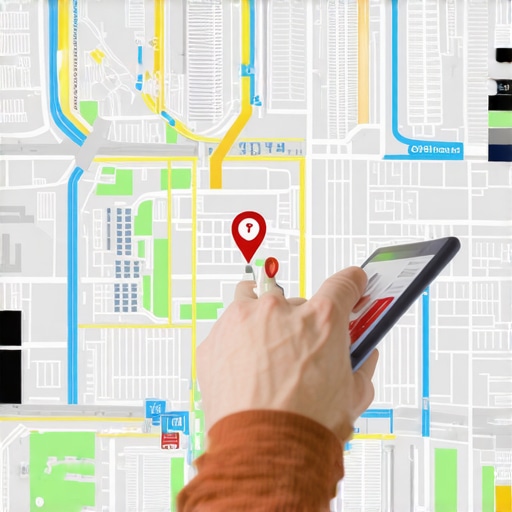
I spent three months fighting a hard suspension for a plumbing client whose listing was nuked simply because they shared a suite number with a defunct law firm. Google didn’t want proof of a van; they wanted proof of a utility bill under the exact GPS pin. This is the reality of the hyper local layer. It smells like wet concrete and fresh asphalt when a new commercial development rises, but to a search engine, that building does not exist until the spatial database catches up. A missing map pin for a new commercial building occurs when the Google Maps base layer lacks the Geographic Coordinate Salience to validate the Physical Address. To fix this, you must manually trigger a Map Edit, verify via Google Business Profile, and ensure Local Schema Markup is deployed on your domain to provide a digital paper trail for the crawler.
The ghost in the GPS coordinates
The Google Maps platform relies on a Base Map updated by third party satellite data and municipal records that often lag behind real world construction. When a new commercial building is completed, the Latitude and Longitude coordinates might point to a vacant lot in the eyes of the algorithm. This creates a data vacuum where your Google Business Profile cannot anchor itself. I have stood on street corners with a camera, documenting the discrepancy between the physical storefront and the digital void. This spatial mismatch is why your profile might get stuck in a verification loop or show as a dropped pin in the middle of a forest. The algorithm prioritizes historical data, and without a history of user pings or WiFi SSID mapping at that location, the trust score is zero.
To overcome this, you need more than just an address. You need a Google maps ranking toolkit for local businesses that includes manual map contributions. Start by using a personal Google account with high Local Guide status to suggest an edit for the missing road or building. This bypasses the standard business verification queue and talks directly to the map editors. If you are struggling with the technical side, the simple fix for business profiles stuck in verification limbo often involves providing proof of occupancy before the building is even indexed. Do not wait for the post office to update their database; they are slower than the search engines. You must be the proactive architect of your own digital location.
“Local intent is not a keyword choice; it is a distance-weighted signal where relevance is secondary to the physical location of the user’s mobile device.” – Map Search Fundamental
Why your physical address is a liability
A new Commercial Building Address is often treated with suspicion by the Spam Fighting algorithms because it lacks Citation Consistency. If your building was recently subdivided, the search engine might see multiple businesses claiming the same Suite Number or Floor Level, leading to a Duplicated Location Filter. This is a common hurdle for GMB optimization toolkit for service businesses because the system cannot distinguish between a legitimate co working space and a fake lead gen office. When the algorithm detects two entities at one coordinate without clear vertical differentiation, it suppresses both. This is not a penalty; it is a safety mechanism to prevent map spam.
You must establish a unique digital footprint immediately. Ensure your suite number is formatted identically across every platform. If you see your competitors appearing while you remain invisible, you might need to investigate why your competitor with fewer reviews is outranking you as it often comes down to the age of their map pin versus your new build status. Use Local Business Schema to define your specific coordinates down to the sixth decimal place. This level of precision tells the crawler exactly where the Point of Interest sits within the larger commercial structure. Without this, you are just a ghost in the machine.
The three mile radius that determines your revenue
The Proximity Signal is the strongest ranking factor in the Map Pack, but for new buildings, the Centroid of the city often pulls traffic away from you. Google calculates the Distance Weight from the user to the business, but if your building location is not yet recognized as a high traffic zone, you lose the Behavioral Zooming advantage. The algorithm looks for Check in Signals and Direction Requests. If nobody has ever requested directions to your new building, the map thinks no one wants to go there. This is why local seo checklist and toolkit for gmb strategies must involve driving real world traffic to the pin.
Consider running a small event or promotion to encourage visitors to use Google Maps to find you. Each time a mobile device with location services enabled arrives at your new building, it sends a Location Salience Signal to the server. This is far more powerful than any backlink. You can also learn how to use local events to steal search traffic to jumpstart this process. The goal is to prove to the algorithm that this coordinate is a destination. If the map doesn’t see people moving toward you, it will never prioritize your pin over an established business five blocks away. Physical movement is the ultimate validation in a mobile first world.
Local Authority Reading List
- The technical guide to fixing map directions
- How site structure influences the map pack
- Strategies for faster map verification
- Verifying service areas for new builds
- Avoiding common GMB name mistakes
The forensic trace of a service area polygon
A Service Area Business (SAB) operating out of a new commercial building faces a double challenge because they often hide their address, which removes the Visual Pin entirely. In these cases, the Service Area Radius must be defined with extreme care to avoid overlapping with existing filters. The Google Business Profile engine uses a Hidden Attribute system to determine if an SAB is actually located where they claim. If your IP Address and GPS Metadata from your mobile device do not match the new building location when you manage the profile, the system triggers a Suspension Loop.
You should use top google business profile seo toolkits to audit your own digital footprint. Many owners make the mistake of setting a radius that is too large, which dilutes their local relevance. Instead of a 50 mile circle, use specific Zip Codes that surround your new commercial hub. This creates a tighter Geofence that the algorithm can more easily verify. If you find your profile is invisible, how to fix overlapping service areas on maps is a critical skill to master. You want to be the dominant entity in your immediate square mile before trying to conquer the entire city. The algorithm rewards density, not spread.
A toolkit to rank higher in local map pack
Winning the Map Pack for a new building requires a Google maps ranking toolkit that integrates technical SEO with local reputation management. The first tool is always User Generated Content. Since your building is new, it likely lacks Street View imagery. You must fix this by uploading high resolution, Geotagged Photos of the exterior and interior. These photos contain EXIF Data that confirms the GPS Coordinates of the building, providing a direct signal to the image search algorithm. I have seen listings jump from page four to the top three just by adding ten authentic photos taken on an iPhone with location services turned on.
The second tool is Review Velocity. A new pin with zero reviews is a red flag for the Spam Filter. You need to gather authentic feedback from your first customers immediately. However, do not use automated bots; the gmb spam fighting and review cleanup services will eventually catch you. Instead, learn how to get your first 10 google reviews without begging to build a foundation of trust. The quality of the reviewer also matters. A review from a Local Guide who has visited other businesses in your area carries ten times the weight of a new account. This is the math of local influence.
“Relevance is determined by the bridge between the user’s query and the verified attributes of the physical location stored in the Knowledge Graph.” – Spatial Search Weekly
Google Business Profile optimization for service businesses
For businesses in new commercial complexes, SEO services to fix slow website and technical issues are just as important as the map pin itself. If your website takes five seconds to load on a mobile device, Google will not feature your pin in the Map Pack because the user experience is compromised. The Mobile CTR (Click Through Rate) is a massive ranking signal. If users click your pin but immediately bounce back to the maps because your site is broken, your ranking will plummet. Technical health is the silent partner of local visibility.
Ensure your Contact Page includes an embedded Google Map of your new location. This creates a closed loop between your website and the map platform. You should also audit your NAP (Name, Address, Phone) data for any traces of the previous developer or old lot numbers. If you are unsure if your site is helping or hurting, the local audit errors that are costing you leads often start at the code level. Fix the Schema Markup, optimize the Meta Tags for local intent, and ensure your H1 Headers mention the specific neighborhood of your new building. This is how you tell the AI exactly where you are and what you do.
The specific reason Google suspended your profile yesterday
New buildings are high risk zones for GMB Suspensions because the data is volatile. If you change your Business Category or Phone Number while the map pin is still in a pending state, the Trust Score breaks. Most suspensions in new commercial developments are triggered by Address Mismatch. The system sees the building as one entity, but you are trying to register a sub entity that doesn’t exist in the Postal Database yet. This creates a conflict that the AI resolves by suspending the newest listing.
If this happens, do not panic and create a second listing. This will only lead to a Duplicate Filter. Instead, follow a step by step guide to fixing a gmb suspension to provide the necessary documentation. You will likely need a Lease Agreement and a Business License showing the new address. If you can, film a video of yourself walking from the street, showing the building number, and entering your office. This Video Verification is now the gold standard for new commercial builds. It provides the forensic proof that the algorithm needs to override the lack of historical data. Your physical presence is your best defense against an automated ban.