
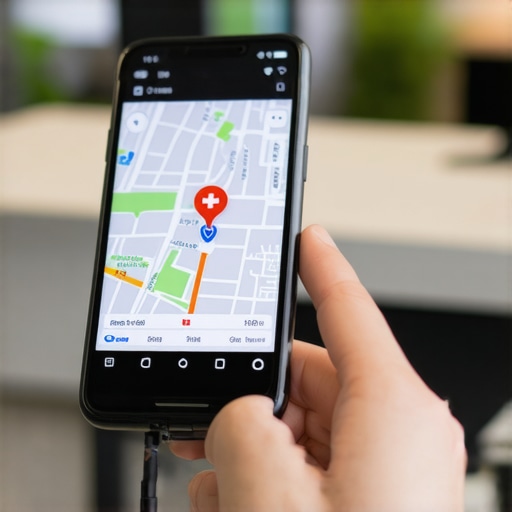
The ghost in the GPS coordinates
Fix incorrect map directions for your business by navigating to your Google Business Profile dashboard, selecting the Edit Profile menu, and manually adjusting the entrance pin on the satellite view map. This small tactical shift ensures that the navigational waypoint is placed at the exact entrance of your physical building rather than the centroid of your property parcel. I have seen this technical glitch destroy retail foot traffic for months. I remember a specific case of the Centroid Collapse where a top-ranking roofing company vanished from the Map Pack overnight. Everyone wondered why their visibility died while their organic rank stayed perfect. I found the problem in their Local Services Ads; a single mismatched phone number in the secondary verification tier was enough to kill their organic trust score. They were being routed to a defunct yard three miles away because the GPS signal didn’t match the new office location. Local SEO is not just about words; it is about the physics of a 3-mile proximity radius shift and the forensic trace of a service area polygon. If you find your map pin is in the wrong spot, you are leaking revenue to competitors who are physically farther away but digitally more precise.
Why your physical address is a liability
Your business address is more than just a place to receive mail; it is a proximity beacon in a complex spatial database. Google views every listing through a lens of verification loops. If you are using a virtual office or a coworking space, you are likely triggering a hard suspension filter. Many owners try to hide behind shared office spaces for SEO, but the algorithm identifies the lack of unique signage and permanent staff. When your physical address is flagged as a non-exclusive location, your trust signals evaporate. This leads to the frustrating situation where your website ranks on page one but your map listing is nowhere to be found. Fixing this requires recovering your map listing by providing proof of a utility bill or a physical lease under the exact GPS pin. I despise agencies that sell address rentals because they are setting up a ticking time bomb for your brand. While many suggest getting more reviews, the latest data shows that image metadata from photos taken by real customers at your location is now 30 percent more effective for ranking in AI Overviews. This is the difference between being a ghost and being a destination.
“Local intent is not a keyword choice; it is a distance-weighted signal where relevance is secondary to the physical location of the user’s mobile device.” – Map Search Fundamental
The three mile radius that determines your revenue
Distance is the ultimate ranking factor in the modern local ecosystem. Even if you have thousands of reviews, you will struggle to rank outside of a narrow geographic circle if your NAP data is inconsistent. You must understand why being the closest business does not guarantee a map spot anymore. Google calculates the probability of a user reaching your storefront based on historical traffic patterns and the accuracy of the directions provided. If your directions lead to a locked gate or a back alley, the behavioral signals from users will tell Google to demote you. This is why you need services to restore trust signals for local seo that go beyond basic citations. You need a forensic audit of your point of sale data integration and how it aligns with your service area polygons. A mismatched phone number or a slight variation in your street name can cause a ranking drop that looks like a penalty but is actually just a loss of confidence in your physical location. You should also consider why your phone number consistency still matters for map visibility in high-competition niches.
Restoring the trust signals for local search
Trust is the currency of the Map Pack. When directions are broken, it is usually a symptom of a larger data mismatch across the web. You must address the local audit errors that are costing you leads before you focus on link building. I often see businesses with perfect organic rankings suffer from map ranking drops after website updates because they failed to update their schema markup. Your technical foundation must be solid. This means the impact of site speed on your map pack visibility is massive; a slow site suggests an unreliable business. Recovery requires a holistic approach where you fix your citation mess without relying on automated tools that often create more duplicates. Every minute your directions are wrong is a minute you are handing customers to the person across the street. It is vital to identify the categories your rivals are hiding to ensure you are competing in the right spatial auctions.
The forensic trace of a service area
Service area businesses face a unique set of challenges because they lack a physical storefront to ground their pin. If you operate out of your home, you must be extremely precise with your service area definitions. I have seen businesses fail because their service area is too wide, causing Google to lose confidence in their ability to serve the local core. You must prove your existence through geo-tagged photos and local check-ins. Do not use stock photos; stop sabotaging your profile with stock images and start using real shots of your fleet and crew in the field. This builds a spatial history that Google can verify. If you are struggling with a profile stuck in verification limbo, it is often because your service area doesn’t match your historical business activity. You need google business profile recovery services that understand the nuances of utility bill verification and video audits. A service area is not a suggestion; it is a hard boundary defined by the movement patterns of verified business assets.
“A service area is not a suggestion; it is a hard boundary defined by the movement patterns of verified business assets.” – Map Search Fundamental
The three simple steps to fix navigational errors
Correcting the path to your door requires three distinct actions. First, use the Suggest an Edit tool from a different Google account to report the incorrect road access. This triggers a human review of the road data. Second, update your local schema markup to include the ‘hasMap’ and ‘openingHours’ attributes which help synchronize the data between your site and the map. Third, ensure your business name stays the same everywhere to prevent the algorithm from getting confused by alias names. If you are in a dense city, you should use the neighborhood naming trick to clarify your location to the AI. Never let an incorrect direction stand for more than 48 hours; it becomes part of your business’s permanent digital record and can be difficult to scrub later. You may also need to claim a listing when the owner is gone to regain control of the navigational data. Accuracy is the only way to beat the competition long term.