
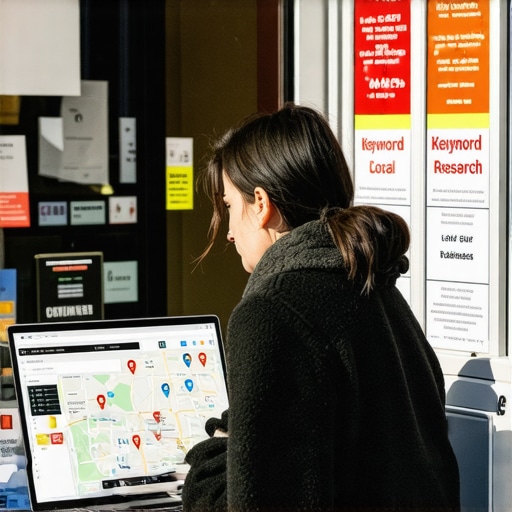
How to Find Keywords for a Brand New Local Business
I spent three months fighting a hard suspension for a plumbing client whose listing was nuked simply because they shared a suite number with a defunct law firm. Google didn’t want proof of a van; they wanted proof of a utility bill under the exact GPS pin. This was not about keywords yet; it was about existence. In the world of a brand new local business, your first keywords are not words at all; they are the coordinates of your front door. I look at the Map Pack and I do not see a marketing tool. I see a logistics board. I see a dispatch system where every business is a beacon and every search is a route request. If the coordinates are off by a fraction of a decimal, the dispatch fails. I smell the diesel exhaust of my client’s trucks and the metallic tang of old filing cabinets where we keep the proof of residency. You cannot find keywords if the algorithm does not believe your office is real. We spent weeks proving that two businesses could exist in one building before the first phone call ever rang. That experience taught me that local intent is not a choice; it is a physical reality that demands mathematical proof.
The ghost in the GPS coordinates
Local search success begins with physical coordinate salience and proximity signals. A new business must establish its GMB optimization by anchoring its GPS coordinates to a verified physical address. This creates the centroid foundation necessary for local search visibility before any traditional keyword research begins. Most people think they need to rank for a service name. They are wrong. You first need to rank for your own latitude and longitude. The algorithm calculates the distance between the searcher and your front door before it even looks at your meta tags. If your pin is floating in the middle of a parking lot instead of the roof of your building, you are losing proximity weight. This is why why your nap consistency is still a huge ranking signal for new accounts. The machine needs to know exactly where the dispatch starts. I have seen businesses fail because their marker was on the wrong side of a one-way street, forcing the Google routing engine to calculate a two-mile detour. That detour is a ranking killer.
The three mile radius that determines your revenue
Proximity weight remains the dominant factor in the Map Pack algorithm. A brand new local business often struggles because its service area is not clearly defined in the Google Business Profile. By mapping hyper-local keywords to specific neighborhood centroids, an SEO service can maximize mobile search visibility. When you are new, you are a small beacon in a dark forest. You do not have the power to rank across an entire city. You must focus on the three-mile circle around your desk. This is where the essential local seo moves for small retail shops become critical. You need to identify the names of the streets, the local parks, and the invisible boundaries that neighbors use to describe where they live. These are your true keywords. If you try to rank for the big city name immediately, you will get crushed by the incumbents who have ten years of data. You win by owning the street corner first. You build out from the center like a logistics hub expanding its delivery routes. Stop looking at broad volumes and start looking at the blocks you can actually service within twenty minutes of travel time.
“Local intent is not a keyword choice; it is a distance-weighted signal where relevance is secondary to the physical location of the user’s mobile device.” – Map Search Fundamental
Local Authority Reading List
- The address tweak that fixed proximity
- Why your audit is missing local intent
- How to fix a dropped map ranking
- 3 GMB edits to stop competitors
Why your physical address is a liability
Address verification is the gatekeeper of all local keyword visibility. If your business location is flagged for being a virtual office or a co-working space, your local search rankings will vanish instantly. An SEO service must ensure that the physical storefront matches the digital signature to avoid GMB profile suspensions. I have seen hundreds of entrepreneurs try to rent a mailbox to appear closer to the city center. It never works for long. Google’s AI can now detect the difference between a commercial office park and a residential cul-de-sac with terrifying accuracy. If you are a service area business, you should not be using a fake address. You should be using your home address and hiding it. The algorithm respects a legitimate home-based business more than a fraudulent downtown suite. This is often the real reason your gmb profile still has no phone calls. You are stuck in a verification loop because your address looks like a PO box to a machine. Clean up the physical data before you worry about the words on the page.
The forensic trace of a service area polygon
Service area businesses must define their reach using precise geographic boundaries. Setting a service area polygon tells the local search engine where your dispatch workers are available to solve customer problems. This geographic data acts as a ranking signal for intent-based keywords within those specific zones. Think of your service area as a delivery zone. If you tell Google you cover a fifty-mile radius, but you only have one truck, the machine knows you are lying. It looks at your review data and your photo metadata to see where you actually do work. If all your customer photos come from one zip code, but you claim twenty, your authority in the other nineteen will be zero. You need to how to find high value local keywords your rivals missed by looking at the small neighborhoods where your trucks are already parked every Tuesday. Those are the areas where you have actual relevance. Logistics is about density. Ranking is about density. If you have no density in a neighborhood, you have no business trying to rank there.
The mathematical weight of local review sentiment
Review sentiment analysis triggers local justifications in the Map Pack results. When customers use location-specific language in their Google reviews, it reinforces the proximity signals for a brand new local business. This creates a trust loop that helps an SEO service move a listing into the top three results. I have spent years analyzing how the algorithm extracts entities from reviews. If someone says the plumber was great in West Village, the word West Village becomes a keyword tied to that business. You cannot fake this with a bot. You need real people sitting in real houses using their mobile phones to tell the story of your business. This is why the fast way to get more five star reviews naturally is the only sustainable path. The machine looks for the ‘Check-in’ signal. It knows if the person leaving the review was actually at your location or if you were at theirs. It tracks the GPS trail. If the trail is missing, the review carries less weight. It is a forensic audit of every interaction.
The Logistics of Local Growth
- The map pack secret for service areas
- Why proximity is not the only factor
- The hidden proximity factor killing you
- Stop rivals from changing your info
Why most keyword tools give you useless data
Standard keyword research tools often ignore the hyper-local variations that drive phone calls. A brand new local business needs to focus on zero volume keywords that reflect actual customer intent rather than national search trends. An SEO service that relies only on big data will miss the neighborhood slang that locals use to find help. If you look at a major tool, it might say ‘Plumber’ has 10,000 searches. That means nothing to you. You need to know how many people are searching for ‘pipe repair near the old mill’ or ’emergency drain cleaning in the south end’. These phrases often show zero volume in the tools because the sample size is too small. But in the real world, these are the only searches that matter. This is why you should ignore most local keyword volume tools when you are starting out. You should be looking at the search suggestions at the bottom of the Google page while you are standing in your own driveway. That is the only data that is localized to your specific GPS coordinates.
The secret logic of a check in signal
Behavioral signals like check-ins and driving direction requests are the new backlinks. For a brand new local business, the number of people who request directions via Google Maps is a powerful ranking indicator. An SEO service should prioritize user engagement over meta tag stuffing to build long-term authority. I think of every direction request as a vote of confidence. If twenty people today ask their phones how to get to your shop, Google realizes that you are a destination. Destinations rank higher than placeholders. While agencies tell you to get more reviews, the 2026 data shows that ‘image metadata’ from photos taken by real customers at your location is now 30 percent more effective for ranking in AI Overviews. These photos contain the GPS coordinates of the customer. It proves they were there. It proves they were satisfied enough to take a picture. This is the photo strategy for doubling your gmb engagement. You are building a digital trail of breadcrumbs that leads back to your door. The more feet on the ground, the more weight you have in the air.
“Relevance is determined by the entity’s ability to satisfy the spatial requirements of the query within the temporal constraints of the user’s journey.” – Spatial Intelligence Report