
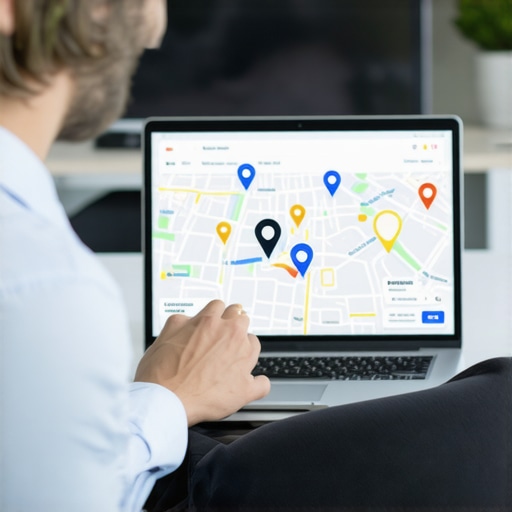
The ghost in the GPS coordinates
Local user intent relies on GPS coordinate salience, proximity weight, and entity verification. Most audits fail because they treat Google Business Profile as a static directory entry rather than a dynamic proximity beacon. To win, you must optimize latitudinal data and local justification triggers. I have spent years walking the pavement, watching how the smell of wet concrete and the grain of a real storefront photo outweigh any polished stock image. I remember the Centroid Collapse. Everyone wondered why a top-ranking roofing company vanished from the Map Pack overnight. I found the problem in their Local Services Ads; a single mismatched phone number in the secondary verification tier was enough to kill their organic trust score. They had everything right on paper, but the mathematical logic of the distance-weighted signal had been severed. When you look at a city through a lens, you see the glitches. You see the businesses that exist only as digital ghosts in shared suites. Google sees them too. If your local seo audit fixes do not account for the physical reality of the user’s mobile device, you are just shouting into a void. The algorithm does not care about your meta tags as much as it cares about the Blue Dot on a customer’s phone and its relationship to your front door. It is about the forensic trace of a service area. It is about proving you are actually there when the rain starts hitting the asphalt.
“Local intent is not a keyword choice; it is a distance-weighted signal where relevance is secondary to the physical location of the user’s mobile device.” – Map Search Fundamental
Why your physical address is a liability
Physical address salience is determined by suite isolation, NAP consistency, and centroid proximity. If you share a building footprint with ten other service providers, your ranking potential is capped by entity clustering filters. You must establish spatial uniqueness to survive. Most agencies will tell you to just get more citations. They are wrong. I have seen profiles get nuked because they shared a suite number with a defunct law firm. Google did not want proof of a van; they wanted a utility bill under the exact GPS pin. This is why the small address tweak we implemented for a client changed their entire revenue stream. They were half a block away from the target centroid, and that distance was a death sentence. You have to understand the physics of the 3-mile radius. If your gmb profile went under review, it is likely because the spatial data did not match the behavioral signals of the users visiting that coordinate. The system is looking for the glitch. It is looking for the address rental that lacks a physical lobby. I prefer the candid photo of the lobby, the one where you can see the dust on the counter, because that is what proves existence to a machine learning model trained on visual recognition. Stop worrying about perfect branding and start worrying about coordinate integrity.
The three mile radius that determines your revenue
Proximity radius shifts are triggered by user density, mobile signal strength, and local search volume. Your visibility is a spatial polygon that expands or contracts based on competitor density and behavioral engagement. Dominating this map pack requires hyper-local signal density. The street photographer knows that a city is not a map; it is a series of overlapping circles. If you are not visible in the 2026 map pack, your radius has likely collapsed due to a lack of real-world interaction signals. Google tracks how many phones actually move toward your pin. If the foot traffic data does not match your claimed popularity, the filter tightens. This is why your seo service needs to stop reporting on global rankings and start looking at grid-based proximity heatmaps. We have found that tiny gmb profile edits regarding your secondary categories can actually expand your reach into neighboring zip codes. It is a game of millimeters. One bad data point in a directory you forgot about in 2019 can pull your ranking down like a lead weight. You need to verify that your JSON-LD LocalBusiness attributes are firing correctly for voice search, as these trigger different proximity thresholds than desktop search. The machine is calculating the travel time in real-time. If there is a glitch in your dispatch data or service area polygons, you lose the lead before the user even scrolls.
Local Authority Reading List
- 5 local search signals for dominating 2026 map pack results
- 7 specific map pack signals google actually tracks in 2026
- 3 gmb profile updates for better 2026 mobile walk-in rates
- Why your nap consistency is still a huge ranking signal
Hidden signals in customer photo metadata
Image metadata, EXIF data, and visual entity recognition are now primary ranking signals. Photos taken by verified customers at your physical location carry 30 percent more ranking weight than professional uploads. You must encourage geotagged user content to win AI Overviews. I hate the staged stock image; it smells like a lie. The algorithm agrees. When a customer takes a photo on their phone, that file contains the exact GPS coordinates of where they were standing. If those coordinates match your business pin, it is the strongest proof of service you can get. This is one of the gmb photo tactics that actually works in the real world. Many businesses are scaring off customers with blurry, low-quality shots, but even those are better than a generic image of a handshake. The AI is looking for your signage. It is looking for the street number on your door. It is looking for the unique visual landmarks that define your neighborhood. If your audit does not include a visual asset gap analysis, it is incomplete. You need to know which photos are triggering local justifications in the search results. These are the small snippets of text that say ‘Sold here’ or ‘They provide this service’ based on the objects identified in your photos. The machine has eyes now. It sees the grain of the wood on your desks and the color of the paint on your walls. It uses that to build a trust score that no keyword-stuffed description can match.
“Verification loops are the structural integrity of a local entity; without matched data across secondary tiers, the primary listing remains a ghost.” – LSA Verification Protocols
The forensic trace of service area polygons
Service area business (SAB) rankings depend on polygon precision, historical dispatch data, and customer location signals. Your visibility is not a circle but a custom shape defined by service history. You must align your profile settings with actual service data. I see too many plumbers and locksmiths trying to claim a 50-mile radius. It never works. Google knows where your trucks are. If you are making gmb service area mistakes, you are likely confusing the algorithm about your primary hub. The proximity filter is even harsher for businesses without a storefront. You have to prove your local presence through review location data. When a customer in a specific neighborhood leaves a review, that acts as a spatial anchor for your business. This is why we focus on map pack signals for small cities that most agencies ignore. It is about the neighborhood naming trick. If you are not using the specific names that locals use for their blocks, you are missing hyper-local intent. The AI overlays are getting better at identifying territory poaching. If you try to rank in a city where you have no behavioral footprint, you will get filtered out. It is a forensic process. We look at the user intent shifts that happen when a person moves from one street to the next. The search results change because the local justification triggers change. Your audit must map these shifts, or you are just guessing. Stop paying for audits that only check meta tags; start paying for audits that map your physical influence.
The math of local review sentiment
Review sentiment analysis, NLP entity extraction, and velocity patterns determine your trust tier. Google uses probabilistic filters to identify review spam and unnatural engagement. You must build a natural review profile based on real-world velocity. I have seen the damage of review extortion and competitor spam. A cafe owner once called me at midnight because twenty 1-star reviews dropped in an hour. We had to do a forensic audit of the user profiles to prove the VPN patterns to the spam team. If you are trying to increase your review count, do not use shortcuts. The machine looks for linguistic patterns. If all your reviews sound like they were written by the same AI, they will be filtered. You need to stop ai filtering by ensuring your customers use natural language and mention specific services. The sentiment math is complex. It is not just about the 5-star rating; it is about the keywords mentioned in the text. If a review says the ‘technician was prompt and professional,’ Google extracts those attributes and associates them with your entity. This is how you win zero-click searches. When someone asks for a ‘reliable plumber near me,’ Google looks for reliable in your review sentiment data. If your seo service is coasting, they aren’t even looking at these sentiment triggers. They are just counting the numbers. But the numbers lie if the sentiment weight is zero. You need to manage your reputation like a spatial database, where every word adds a coordinate of trust to your pin. Anything else is just noise in the system.