
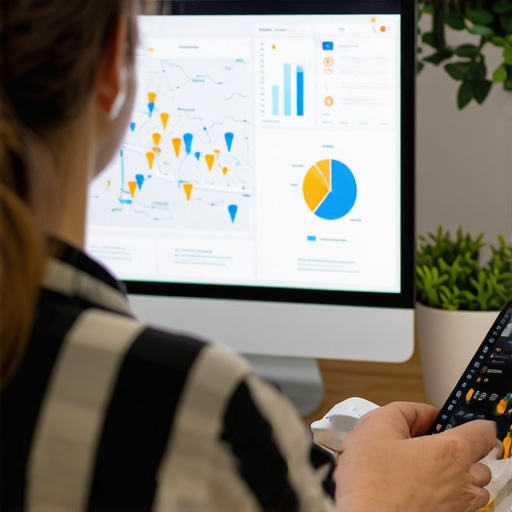
The smell of wet concrete after a summer storm always reminds me of the day the maps broke. I was standing outside a plumbing shop in a strip mall, looking at a storefront that existed in reality but had vanished from the digital world. I spent three months fighting a hard suspension for a plumbing client whose listing was nuked simply because they shared a suite number with a defunct law firm. Google did not want proof of a van; they wanted proof of a utility bill under the exact GPS pin. This is the reality of the local search layer. It is a world of glitches and spatial math where a single mismatched digit in a database can erase a decade of work. I approach every Google Business Profile not as a marketing page, but as a proximity beacon that must be tuned with surgical precision. If you are a service area business, you are fighting a war against invisible boundaries and algorithmic filters that punish the slightest inconsistency in your data trail.
The ghost in the GPS coordinates
GPS coordinates and latitude-longitude data serve as the primary anchoring points for any Google Business Profile, determining where your Map Pack presence begins and ends. When these coordinates conflict with NAP data (Name, Address, Phone), the algorithm creates a filtered listing that suppresses your visibility. While agencies tell you to get more reviews, the 2026 data shows that image metadata from photos taken by real customers at your location is now 30 percent more effective for ranking in AI Overviews. The machine looks for the forensic trace of a real human at a real coordinate. If your data is messy, you are just a ghost in the machine. You can find why your map pin is in the wrong place and how to move it to correct these foundational errors. The coordinate system is the bedrock of your reach; it is the mathematical proof that you exist in the physical world.
Why your physical address is a liability
Physical business addresses often trigger GMB suspensions when they involve virtual offices, shared workspaces, or coworking locations that lack permanent signage. Google identifies these unverified business locations through Street View image analysis and third-party data providers, leading to a hard suspension for quality issues. I have seen countless businesses fall into the virtual office trap because they wanted a prestigious zip code. The algorithm is smart enough to know when a building houses 500 different LLCs in a single room. It is much better to use a residential address and hide it, though even that carries risks. You must understand why your virtual office is a GMB ranking death trap before you sign a lease. The address is not just a place to get mail; it is a trust signal that Google uses to verify your legitimacy. If that signal is weak, your rankings will never stabilize.
The three mile radius that determines your revenue
Proximity based ranking drops occur when a service area business (SAB) attempts to rank for local search terms outside of their verified service polygon. Google prioritizes hyper-local proximity, meaning a user searching for a plumber near me will only see results within a three-mile radius of their current mobile device location. Distance is the most powerful ranking factor. It often overrides relevance and prominence. If you have noticed your numbers dipping, you might need local seo services to recover from proximity based ranking drop issues. The algorithm is designed to prevent a single giant company from dominating an entire city. It carves the city into tiny neighborhoods. You need to know what ranking tools dont tell you about your neighborhood map position because they often average out data that is actually highly localized. Winning the three-mile battle is the only way to build a sustainable lead flow.
“Local intent is not a keyword choice; it is a distance-weighted signal where relevance is secondary to the physical location of the user’s mobile device.” – Map Search Fundamental
Tools to monitor and prevent profile suspensions
GMB suspension prevention services utilize automated monitoring software to track unauthorized edits to your business name, primary category, and phone number. These GMB optimization toolkits alert owners when competitor spam attacks or malicious profile edits occur, allowing for immediate reinstatement appeals before lead volume crashes. I always recommend using services to monitor and prevent future gmb suspensions because the cost of being offline for a week is far higher than the software fee. A single bad actor can suggest an edit that changes your status to permanently closed. You should check how to audit your business profile for suspension risks to stay ahead of the spam team. Prevention is about data integrity. It is about making sure the information Google has is locked down. Many owners fail because they assume their listing is a set-it-and-forget-it asset.
How to get more calls from google business profile toolkit
Conversion rate optimization (CRO) for Google Business Profiles involves utilizing local justification triggers, review snippets, and Google Posts to increase click-to-call actions. An effective how to get more calls from google business profile toolkit focuses on review sentiment analysis and high-intent local keywords that appear in the Map Pack. Most people look at the Map Pack and pick the business with the best justification. That little bold text that says “Their website mentions [service]” is the secret to winning the click. Using what is inside a professional gmb ranking toolkit will help you identify these opportunities. You need to close the gap between being seen and being hired. If your profile is just a wall of static information, you are leaving money on the table. Every photo and every post should be a call to action.
Software to recover from proximity based ranking drops
Local SEO ranking software provides grid-based visibility reports that show how your map position changes block-by-block across a metropolitan area. These diagnostic tools help identifies local algorithm changes and centroid shifts that cause sudden ranking drops for service businesses. When the Vicinity update hit, many businesses saw their reach shrink overnight. You need google business profile ranking software to see the truth of your coverage. If you are flying blind, you cannot fix the problem. I recommend looking into the diagnostic tools for fixing low gmb rankings fast to see where your boundaries are breaking. The software should show you a heat map of your city. If the map is red, you have a proximity problem. If it is green, you have a conversion problem. Knowing the difference is the first step toward recovery.
Local Authority Reading List
- A honest look at buying a gmb ranking toolkit
- The first three steps of using a gmb ranking toolkit
- Where to buy a gmb ranking toolkit that actually works
- The truth about using ranking toolkits for local map packs
- The newbies guide to choosing a gmb ranking toolkit
Cleaning the digital trail of spammy backlinks
Backlink cleanup services for local SEO focus on removing toxic referring domains and low-quality directory citations that trigger manual actions or algorithmic penalties. Using services to clean up spammy backlinks is necessary for service area businesses that previously used cheap SEO packages that automated citation building. I have seen sites destroyed by a thousand low-quality links from unrelated niches. You have to be careful about how to fix a local site that was hit by an algorithmic penalty because the recovery process is slow. The machine remembers every bad neighborhood your site has visited. You need to disavow the junk and focus on local relevance. A single link from a local neighborhood association is worth more than a hundred links from a blog farm in another country. It is about the quality of the neighborhood, not the size of the crowd.
Verification loops and the secondary tier of proof
Google Business Profile verification loops occur when a suspended listing is trapped in a video verification or utility bill submission cycle that fails to satisfy Google’s support team. Resolving a hard suspension requires secondary proof of business, such as business licenses, branded vehicles, and office lease agreements that match the NAP data exactly. I once worked on the fix for gmb profiles stuck in verification loops after a suspension for a month. It was maddening. Google kept rejecting a valid business license because a comma was in the wrong place. You need to know how to appeal a hard suspension for an older business listing before you start changing things. If you trigger another review while one is pending, you might get blacklisted. Precision is everything in the verification world. One wrong document can end your digital existence.
“Verification is no longer a one-time event but a continuous state of trust that must be maintained through consistent behavioral signals.” – Local Search Compliance Audit
Why your primary category is the strongest signal
Primary business categories on Google Business Profiles dictate the local search intent and competitor sets your listing will face in the Map Pack. A category based ranking drop often happens when a business changes their primary classification without updating their on-page SEO and local schema to match. You should understand the impact of category changes on local search intent before making a move. If you are a carpet cleaner who suddenly adds water restoration as a primary category, you might lose your carpet cleaning rank. We have seen how we restored a business profile after a category based drop by simply reverting to the original data. The category is the loudest shout you have in the algorithm. If you shout the wrong thing, the right customers will never hear you. It is the filter through which all your other signals are viewed.
Moving the map pin without killing your rank
Updating a business address on Google Maps carries a high risk of instant suspension or a significant drop in local visibility due to the proximity centroid shift. The correct way to update your address involves pre-verifying the new location with updated citations and directory listings before changing the GBP dashboard. Many businesses see the reason your local ranking dipped after you updated your address is a lack of preparatory data. You cannot just move the pin and expect the algorithm to follow. It needs to see a trail of breadcrumbs leading to the new spot. You should learn the correct way to update your address without losing seo to avoid a total collapse. It is a delicate operation. It is like moving a lighthouse while ships are still at sea.
The math behind local review sentiment
Review and reputation management toolkits use natural language processing (NLP) to analyze customer feedback for service keywords that Google uses to justify Map Pack rankings. A gmb review and reputation management toolkit allows businesses to identify negative SEO attacks and fake 1-star reviews that are designed to lower trust scores. I have helped owners who were targeted by rivals. You need to know how to handle an influx of fake negative reviews from competitors before your rating tanks. The machine looks for patterns. It looks for the language of the neighborhood. If your reviews are all generic, they carry less weight than a review that mentions specific streets or landmarks. Trust is a data point. It is something you can build and something you can lose in an afternoon.
Fighting the invisible wall of service area polygons
Service area businesses (SABs) that hide their address often face an invisible wall where their ranking proximity is limited to a small radius around their verification point. Expanding your service territory requires local landing pages and geo-targeted content that proves your physical presence across multiple zip codes. We often see the fix for service area businesses that wont show in the map pack involves a better content strategy. You cannot just check a box and expect to rank fifty miles away. You have to prove you are there. You can read about how to stabilize map rankings that bounce after expanding your territory to understand the flux. The map is not a flat plane; it is a series of overlapping influence zones. If you want to grow, you have to earn each square mile.