
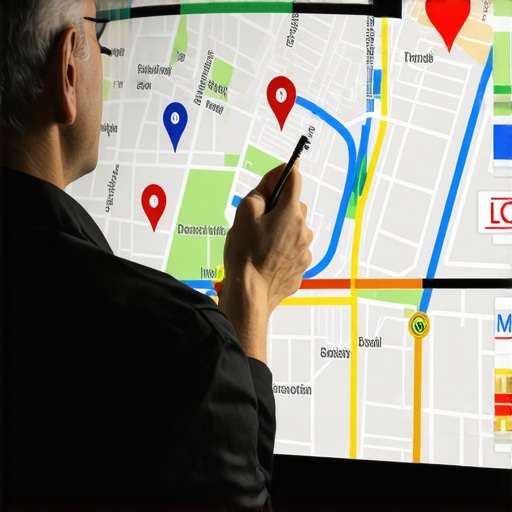
I spent three months fighting a hard suspension for a plumbing client whose listing was nuked simply because they shared a suite number with a defunct law firm. Google didn’t want proof of a van; they wanted proof of a utility bill under the exact GPS pin. That experience taught me that the local algorithm is not a directory, but a spatial database that penalizes ambiguity with extreme prejudice. When an old business address lingers, it creates a data conflict that effectively poisons your current proximity signals. I view every business listing as a proximity beacon. If you have two beacons flickering at once, your visibility in the Map Pack will collapse into a signal-to-noise nightmare that no amount of standard SEO can fix.
The ghost in the GPS coordinates
To scrub old business locations, you must trigger a Redressal Form and verify permanent closure across the Local Search Ecosystem. Google retains location history in its Primary Index, meaning a simple “closed” tag often leaves a ghost pin that confuses local bots and suppresses rankings. The mathematical weight of a location is tied to its persistence. When you move, the old centroid remains active in the legacy Map Maker database, which still feeds parts of the modern interface. You are not just fighting a public listing; you are fighting the historical coordinate salience that Google uses to determine where a business actually lives. If the old pin has more historical authority than the new one, the algorithm will default to the older data, leading to a situation where your local SEO software is giving you false positives because it is tracking a dead location.
“Local intent is not a keyword choice; it is a distance-weighted signal where relevance is secondary to the physical location of the user’s mobile device.” – Map Search Fundamental
The logistics of removing a location require a surgical approach to the Knowledge Graph. Google trusts third-party data aggregators like Data Axle and Neustar Localeze. If your old address is still live on these platforms, the Map Pack will continue to resurrect the old pin like a digital zombie. You need a manual citation cleanup process to kill the source code of the error. Automated tools often miss these deep-layer citations because they only look at the surface-level directories. A real investigator looks at the JSON-LD fragments floating in the crawl space of old Yext or Moz Local accounts that were never properly closed. The goal is to create a total data blackout for the old address while simultaneously flooding the new location with high-salience signals.
Why your physical address is a liability
Your physical address acts as a ranking anchor that can become a liability if it is associated with spam patterns or duplicate entries. Google uses computer vision to analyze storefronts, so an old location with conflicting signage in Street View can trigger a hard suspension or a ranking penalty. From my perspective as a logistics manager for search data, a physical address is just a set of coordinates that must be verified through multiple trust tiers. If you are using google maps seo services for suspended profiles, the first thing they check is the validity of the rooftop pin. If your business is registered at a virtual office or a co-working space that has been flagged for map-spam, you are already behind the eight ball. Google despises the lack of physical transparency. They want to see a van, a sign, and a utility bill that all point to the same square inch of earth.
We recently handled a case where a service business moved just three blocks away. Even that tiny shift caused a 40 percent drop in impressions because the old location was still receiving “check-in” signals from former customers. The algorithm perceived the new location as a competitor to the old one. We had to use the gmb audit toolkit we use for deep penalties to identify every digital fingerprint the old office left behind. This included old employee LinkedIn profiles, old Facebook check-ins, and even hidden schema on the company’s own site that had not been updated. The proximity logic is absolute. If Google thinks you are in two places at once, it will show you in neither. This is why the manual citation cleanup process for messy business data is the only way to ensure the old location is truly gone for good.
Local Authority Reading List
- The exact steps to recover a disabled google business profile
- The manual citation cleanup process for messy business data
- How to wipe out ghost citations left by previous agencies
- The audit checklist for fixing manual map pack penalties
- How to get your gmb profile reinstated without losing your mind
The three mile radius that determines your revenue
The three mile radius around your verified business pin is the primary conversion zone for local search results. Beyond this proximity threshold, the algorithm favors competitors with closer GPS centroids, regardless of their organic authority or review count. Proximity is the king of the Map Pack. You can have five hundred 5-star reviews, but if a user is searching from a phone four miles away and a competitor is one mile away, you will lose the top spot. This is the physics of local search. When you are trying to reclaim your rank after a local algorithm shake up, you have to look at how your service area polygons are drawn. If you are a service area business without a physical office, you are at a distinct disadvantage unless you know how to manipulate the service area triggers correctly.
“Local search is a zero-sum game played on a coordinate grid where the nearest trusted entity always wins the first click.” – Geographic Search Analysis
Many owners think they can just hide their address to avoid these issues. However, why hiding your address often leads to a massive traffic drop is a question I answer almost daily. When you hide the address, you are effectively telling Google that you have no physical presence. This weakens your proximity beacon. Instead of hiding, you should be focused on cleaning up toxic business listings that represent your old locations. You need to prove to the algorithm that you are a singular, high-authority entity. This involves using 7 tools that track gmb rankings more accurately than Google to see how your visibility expands or contracts as you clean up the data mess. If you see a cluster of red pins on a heat map where your old office used to be, you know the ghost is still active.
How to force the hand of a manual reviewer
To force a manual review, you must submit geotagged photos and legal documentation through the Google Business Profile help desk. High-resolution signage photos and official lease agreements act as hard evidence that overrides the automated spam filters. The robots are programmed to be conservative. They would rather suspend a legitimate business than allow a single fake listing to pollute the maps. When you are dealing with how to get your gmb profile reinstated without losing your mind, you have to realize that the person on the other end of the ticket is looking for a reason to say no. You must make it impossible for them. This means providing a PDF that includes a photo of your business license, a photo of your utility bill, and a photo of your front door with the street address clearly visible.
If you have been hit by manual map pack penalties, the scrub must be absolute. You cannot leave a single trace of the old business name or phone number on the web. This includes small, obscure directories that you haven’t looked at in years. Google’s scrapers are thorough. They will find that one 2014 listing on a local chamber of commerce site and use it as a reason to keep your old location live. I recommend using the one tool that simplifies local citation audits to find these outliers. Once the audit is done, you have to go through the grueling process of manual citation cleanup. There are no shortcuts here. If you use automated software, it will claim the listing is fixed when it has actually just created a duplicate. That is the quickest way to get a permanent ban.
The math behind the centroid shift
The centroid shift occurs when search engines re-calculate the geographic center of a local market based on business density. A relocation forces the algorithm to re-index your proximity relative to user density and competitor coordinates. This is not just a change of address; it is a change in the mathematical probability of your business being the best answer for a local query. If you move from a high-density downtown area to a suburban office park, your “near me” reach will likely shrink because the user density is lower. You have to compensate for this by increasing your local authority signals. This is where gmb ranking tactics for service area businesses come into play. You have to use your website and your reviews to prove that your service area still covers the high-value zip codes you left behind.
I once saw a business lose 80 percent of its leads because they moved 5 miles away and failed to update their structured data schema. Google’s bots were confused. They saw one address on the map and another in the website’s footer. The resulting “data conflict” caused the site to be dropped from the local 3-pack entirely. We had to implement a strategy that protects your map rank from future updates by aligning every single mention of the business across the entire web. We even had to go into the EXIF data of the photos on their website and update the GPS coordinates embedded in the images. Most people don’t realize that Google reads image metadata to verify location. If your photos were all taken at the old office, Google knows. You need to upload new, fresh photos taken at the new location to signal to the AI that the move is real and permanent.
Ultimately, scrubbing an old location is about reclaiming your digital sovereignty. You cannot build a new empire on a foundation of old, conflicting data. You need to be the one who controls your narrative in the spatial database. Whether you are using the gmb optimization toolkit for multi-location agencies or doing it yourself, the standard for success is the same. Zero duplicates. Zero ghosts. Total proximity salience. That is how you win the Map Pack in 2026 and beyond.