
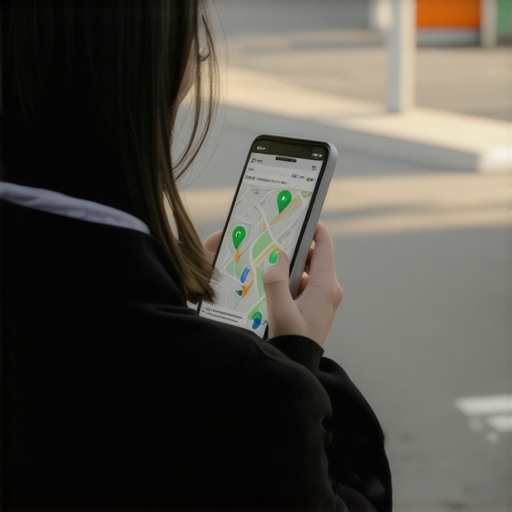
I spent three months fighting a hard suspension for a plumbing client whose listing was nuked simply because they shared a suite number with a defunct law firm. Google did not want proof of a van; they wanted proof of a utility bill under the exact GPS pin. That experience taught me that the local algorithm does not care about your marketing fluff. It cares about the cold, hard logic of spatial verification. If your landing page does not mirror the physical reality of your business, the map pack will swallow you whole. I have walked the streets of commercial districts where the storefront data had a glitch. One shop would rank three blocks away from its actual door because of a stray signal from a nearby Wi-Fi router. These are the details that matter for mobile users who are walking, driving, or searching from a sidewalk. You cannot hide behind a desktop-first strategy anymore. Your mobile performance is your reputation.
The ghost in the GPS coordinates
Mobile users trigger proximity signals that calculate the physical distance between their device and the business centroid. To dominate this layer, your landing page must serve as a high-fidelity beacon that confirms your location to the millisecond. When a user is on the move, Google prioritizes businesses that reduce the friction of physical travel. If your page takes more than two seconds to load on a 4G connection, you have already lost the proximity battle. You need to understand why your mobile site speed is the key to local clicks and how it influences the algorithm’s trust in your location. Most agencies ignore the latency of the local map overlay, but I see it as a primary ranking signal. The local search engine is effectively a dispatch system. It wants the fastest, most reliable answer for a user who is often in a hurry.
Why your physical address is a liability
Local landing pages must reconcile the discrepancy between the registered address and the actual service area radius for mobile visibility. If you are using a virtual office, you are sitting on a ticking time bomb. I have seen entire networks of listings vanish because they used the same suite number as twenty other “businesses.” To fix this, you need a strategy that proves your physical presence. This involves why your virtual office address is a hazard for long-term growth. Use your landing page to host unique, unedited photos of your storefront or service vehicle. Stock photos are a death sentence for mobile conversion. When a customer sees a generic image, they assume your business is a ghost. I recommend a specific photo strategy for doubling your GMB engagement that focuses on authentic, geo-tagged imagery. This provides the forensic evidence Google needs to trust your proximity.
“Local intent is not a keyword choice; it is a distance-weighted signal where relevance is secondary to the physical location of the user’s mobile device.” – Map Search Fundamental
The three mile radius that determines your revenue
Proximity factors on mobile devices prioritize businesses within a tight geographical cluster based on real-time location data. If your landing page does not mention specific neighborhood names or local landmarks, you are invisible to the users on that specific block. I often find that businesses fail because they target the whole city instead of the hyper-local grid. You can find the proximity factor most small shops ignore by analyzing your competitors’ location mentions. Every H2 on your landing page should lean into the local vernacular. This includes using neighborhood nicknames that do not appear on official maps. This is the hidden neighborhood names tactic that drives traffic from people who actually live there. Do not just say you are in Chicago; say you are two blocks south of the Wicker Park fountain. That level of detail creates a local justification trigger in the search results.
Local Authority Reading List
- The local SEO audit checklist for every business owner
- How to optimize your website footer for local reach
- The manual check every local SEO audit should include
- How to fix map proximity issues for service area businesses
- Why your business name is secretly hurting your map rank
The forensic cleanup of legacy map spam
SEO services to clean legacy black hat local SEO footprints focus on removing inconsistent NAP data and cleaning historic citation spam campaigns. If your business has moved three times in five years, your digital footprint is a mess of conflicting coordinates. The mobile algorithm sees this inconsistency and de-ranks you to protect the user from a bad experience. You need a deep audit to find and fix why your NAP consistency might still be an issue despite what the gurus say. It is not just about the name, address, and phone number; it is about the metadata buried in old directories. Using tools to find GMB categories and keywords helps, but a manual check is the only way to ensure the cleanup is complete. I have spent nights hunting down 10-year-old Yelp clones just to delete a phone number that was redirecting to a competitor. That is the grit required to win in the current Map Pack.
The logic of the mobile click through
Conversion on mobile local landing pages depends on the immediate visibility of click-to-call buttons and map directions. If a user has to scroll to find your phone number, they will bounce back to the Map Pack and pick your rival. You must understand how to get more phone calls fast by streamlining the mobile UI. I often see businesses obsessed with their desktop layout while their mobile page is a cluttered disaster. The “near me” searcher is looking for a solution, not a story. Provide them with a clear path to contact you. Use the review response secret to show potential customers that you are active and responsive. A landing page that features recent, positive review snippets from mobile users creates a social proof loop that is hard to beat. This is especially vital for local plumbers and electricians who rely on emergency calls.
“Local search success is a game of millimeters where the accuracy of your structured data defines the boundaries of your digital storefront.” – Location Intelligence Whitepaper
The toolkit for local search dominance
A GMB ranking toolkit provides the necessary diagnostics to compare your profile against other local SEO tools for category accuracy. You need to know if you are using the right primary category. A single mistake here can cut your visibility by half. I recommend looking at the tweak to your primary category that can double your leads. Once the categories are set, you must audit your schema. Using services to fix schema and structured data errors is the only way to ensure AI search engines can read your location properly. If the schema says one thing and the footer says another, the search engine will default to the most conservative (and lowest) ranking. This is why a manual check is indispensable. You cannot trust an automated tool to understand the nuances of a local neighborhood. It takes a human eye to see the glitch in the data.