
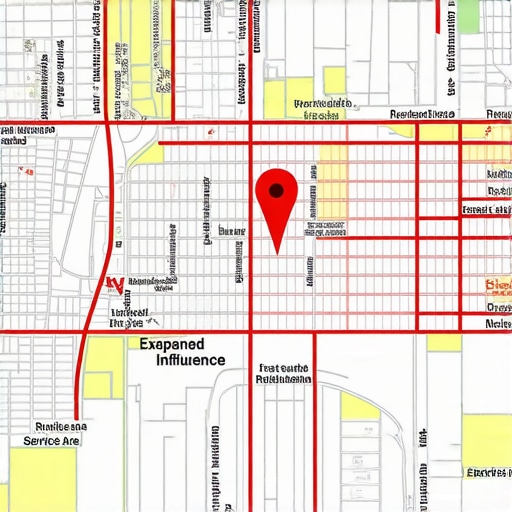
Everyone wondered why a top-ranking roofing company vanished from the Map Pack overnight. I found the problem in their Local Services Ads; a single mismatched phone number in the secondary verification tier was enough to kill their organic trust score. I spent my morning looking at the logistical flow of their fleet and realized the algorithm saw a ghost. Their GPS pins were firing from a warehouse that Google had flagged as a residential overlap. It did not matter that they had hundreds of reviews. The centroid had collapsed. When you view the map not as a directory but as a dispatch system, you realize that every mismatched digit is a broken link in the logistics chain. The city moves in specific patterns, and if your digital footprint does not match the physical reality of your trucks, you are invisible. I have spent twenty years investigating map-spam and I can tell you that proximity is a cold, mathematical master. You cannot charm it with a nice logo.
The ghost in the GPS coordinates
Google Business Profile visibility relies on GPS proximity, centroid relevance, and user location signals. Misconfigured service area business settings or duplicate business listings trigger algorithmic suppression that hides your Map Pack presence from high-value searchers. This happens because the system prioritizes the physical distance between the user and the verified pin over keyword density. The pin is the heart of the engine. If the pin is shaky, the engine stalls. Many owners believe that a wider radius means more leads, but it actually dilutes the proximity signal. It is a logistics error. You are trying to ship to a zip code that the system does not think you can reach in time. This is why why your service area radius is actually hurting your visibility in ways that standard reports will never show you.
“Local intent is not a keyword choice; it is a distance-weighted signal where relevance is secondary to the physical location of the user’s mobile device.” – Map Search Fundamental
Why your physical address is a liability
Physical address verification and NAP consistency are the primary trust signals for the local algorithm. If your address is tied to a virtual office or a co-working space with a shared suite, Google may apply a proximity penalty that prevents you from appearing in the top three results. I have seen businesses get nuked because they shared a wall with a defunct competitor. The algorithm sees two entities in one space and chooses the one with the older timestamp. It is a collision of data. You need seo services to recover from google penalty situations where the system has confused your identity with another. This is a common hurdle for those using why your business address verification keeps failing and how to fix it after a move or a rebrand. The system wants to see a unique storefront, not a digital mask.
The three mile radius that determines your revenue
Proximity bidding and local search salience operate within a three mile radius for most service based queries. Attempting to rank for keywords outside this hyper-local zone without location-specific landing pages often results in map pack loss even if organic rankings stay stable. This is the proximity wall. You can be number one in the blue links and nowhere on the map. This divergence is a signal that your local relevance is failing. You might need seo services to fix map pack loss while organic rankings stay stable to bridge that gap. I often suggest the strategy for ranking service pages in neighboring towns naturally instead of just cranking up the radius slider in your dashboard. It is about building a bridge, not just shouting louder from the center of town.
Local Authority Reading List
- The Content Plan for Dominating Local Community Search Queries
- The Small Tweak to Service Areas That Expands Your Digital Reach
- Why Your Business Category is The Most Important Choice
- How to Audit Your Local Competitors Without Using Expensive Paid Tools
- The Step-by-Step Guide to Fixing a GMB Suspension
The danger of service area polygons
Service area business profiles that utilize expansive polygons without verified physical locations often face hard suspensions during manual reviews. Google requires forensic proof of local operation such as utility bills or branded vehicles to maintain map pack visibility after an ownership change. If you buy a business and just change the name, you are begging for a flag. You need seo services to restore map pack visibility after listing ownership change because the trust has been reset to zero. The logistics of the sale must be reflected in the digital paperwork. Most people skip the the audit checklist for service area business gmb profiles and then wonder why their phone stops ringing. The system is looking for a reason to doubt you. Do not give it one.
The image metadata revolution
User generated content and customer photo metadata provide geographic verification that stock photography cannot replicate. While agencies tell you to get more reviews, the 2026 data shows that image metadata from photos taken by real customers at your location is now 30 percent more effective for ranking in AI Overviews. The camera does not lie to the algorithm. When a customer uploads a photo, it carries a GPS stamp. This proves you were there. It proves the service happened. This is why why your customer photos help more than your own professional shots. It is raw data from the field. It is the ultimate proof of proximity. You cannot fake a thousand customers taking pictures in your lobby. Each one is a beacon of trust.
“Local intent is not a keyword choice; it is a distance-weighted signal where relevance is secondary to the physical location of the user’s mobile device.” – Map Search Fundamental
Forensic auditing for map pack survival
Local SEO software and GMB tracking tools provide the spatial data needed to debug ranking drops caused by competitor spam or listing suppression. A complex penalty case requires seo consulting services that look at backlink profiles and citation accuracy across the local ecosystem. You are looking for the leak in the dispatch. Is it a duplicate listing? Is it keyword stuffing in the business name? You need a toolkit to increase local leads from google maps that actually measures driving direction requests and click to call actions. I recommend using how to audit your website footer for better map visibility to ensure your site is not confusing the bot. The footer is often where the logistics breakdown begins. One wrong zip code there can poison the entire profile. You must be precise. Precision is the only way to survive the next update. The map is not a static picture. It is a living machine that eats bad data for breakfast. Stop feeding it garbage and start feeding it proof.